Introduction
Activision's classical Civilization: Call to Power is finally available for the Linux operating system from Loki Entertainment Software. For all you game freaks, who spend all your time in front of the screen, this is one strategy and action-filled game that you cannot miss. This game will never end up on that top dusty shelf or behind the computer with all the other useless CD's and junk. Journey through time as your civilization expands from a small primal colony to an immense empire in outer space, all controlled by you through global domination and trade. Take a trill ride through history as you modernize and cultivate your land for combat and expansion. If you think you have the courage to face the challenges of global warfare, managing a prosperous empire, fighting alien intelligence in deep space, then Civilization: Call to Power is for you.
Installation
The minimum system requirements for the installation are: Linux kernel 2.0.x or 2.2.x and glibc-2.x or libc5, a Pentium 133 MHz, PowerPC 133 MHz or Alpha processor, a 4-speed CD-ROM drive, 32 MB RAM required, 80 MB swap, OSS compatible sound card, 400 MB free hard drive space, 225 MB extra for video install, and a working X Windows system with 16-bit color. In addition, you will need an Internet connection for multiplayer games.
Currently Civilization: Call to Power supports glibc-2.0 and libc5, but not glibc-2.1, which means it probably won't work under the major distributions such as Red Hat 6.0. If you know your way around a Linux box then the installation will be a breeze, even on an older system, otherwise installation may cause you to bend and twist your brain a little. I found that the manual included in the box is not very helpful when it comes to installing the game, but there is a small README.txt file located on the CD. Even with thist file, I think the installation might be quite challenging for some novice Linux users.
I have tested the game on a PII-200Mhz processor, 32 MB RAM, 24x CD-ROM drive, a compatible sound card, and running Red Hat Linux 7.0. The game ran pretty smoothly, but there were some minor glitches. The screen sometimes froze or sometimes after the movie stopped; a black screen would come up until you clicked on it. If you have a slow machine or your hard drive's capacity is limited, then you need to upgrade, if you plan on playing this game a great deal.
Features
Upon starting the game, you are shown a movie clip about Civilization: Call to Power. The movie is in a MPEG format and it is played with Loki's own internal MPEG player. The start-up screen is pretty straightforward, you choose whether you want to play the single player scenario or start a multi-player session. You always start with your civilization at 4000 BC and expand your empire until 3000 AD. There are always new lands and weaponry to be discovered and harnessed.
Civilization: Call to Power is readily suited to be played on the Net with fellow gamers. You can create new campaigns and scenarios with the scenario builder and challenge other players with your masterpieces. Learning to trade, developing peace, or dominating other civilizations is even more fun while playing on the Internet against other human beings. You can also play on your Linux box against other players playing on Windows, if you have the recent 1.1 patch. In multi-player mode you select which server to compete on and after you've logged in you can chat with other player or join games that are currently running.
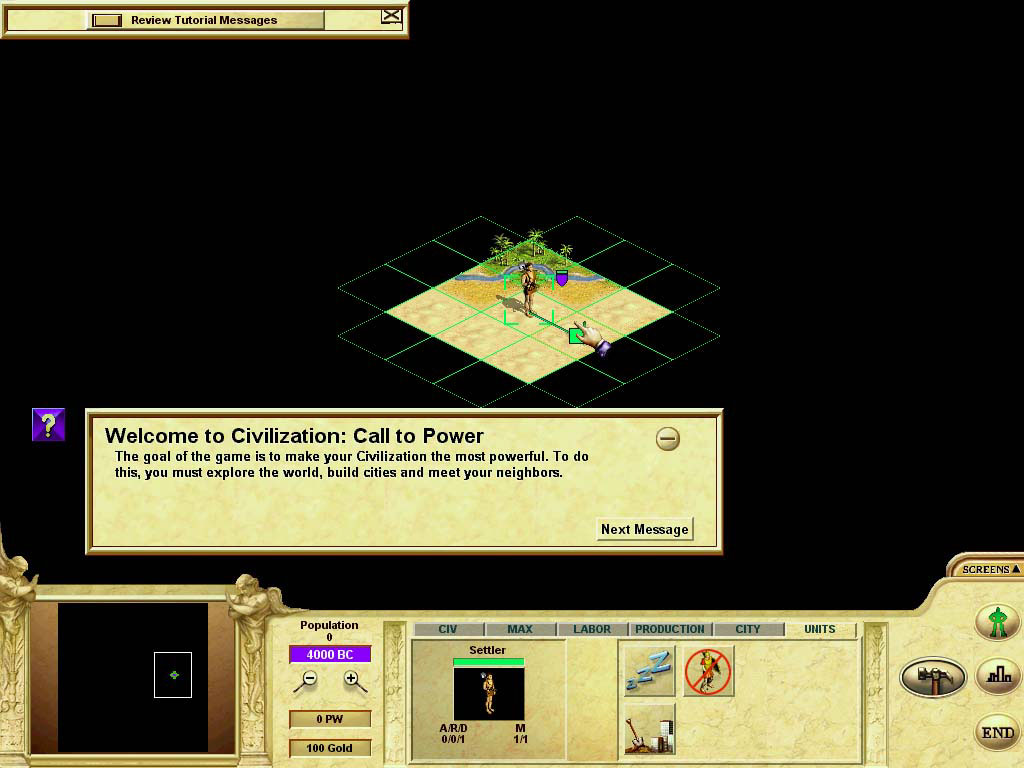

You start at 4000 B.C and build from there.
Gameplay
Basically, the objective of the game is to expand your civilization either by warfare or by researching new technologies that can benefit your empire. You must also defend your empire against attacks, even if you choose a path of peace. If you are not familiar with the game, then I suggest that you start with the tutorial which is quite good.
In the single player scenario, you have to cultivate the area, construct buildings, and create units. There are many different kinds of units each with a designated role. For example, you can develop "settler" units that specifically work on the land, and you can produce "military" units that defend your cities and attack foreign civilizations. You can control the actions of these units and assign tasks and jobs for them to do. Through funding research and technological developments you can build bases in deep space and under water.
Graphics
The graphics are a real strong point of the game, along with the sound track. The graphics are very detailed and textured beautifully, they really intensify the action. The video and graphic modes are easily adjustable and comply with your system settings. One note about the sound and video clips: you can choose to either install the sound tracks or movies on your hard disk, requiring 255 MB free space, or run them from the CD, which will run them a little slower, depending on your setup. I would reccommend a hard disk installation though, as just the graphics and sound were enough to convince me to get intensely involved in the game and never stop playing, or it may have been the fact that I drank 20 cans of diet coke before starting the game


Overall
Civilization: Call to Power is one hell of a game that will meet your cravings for action and strategy. If you have ever dreamed of becoming a ruler, now is your chance to make your dream a virtual reality. Two Thumbs up for Loki, for porting a gaming sensation to Linux.